
Introduction
Cost Per Milli, usually shown as CPM, is one of the foundational metrics in digital advertising. If you are a digital marketing student or intern learning Google and Facebook ads, understanding CPM will help you plan budgets, choose creative formats, evaluate channels, and judge campaign efficiency when reach or awareness is the goal. CPM is impression-based: you pay for exposure rather than clicks or conversions. Because of that, CPM is most useful for top-of-funnel activities where repeated visibility, storytelling, and scale matter more than immediate actions.
This post explains CPM in plain terms, shows the calculation with worked examples, covers CPM variants such as vCPM and eCPM, explains how major platforms (Google, YouTube, Meta) treat CPM, lists what drives CPM up or down, provides approximate benchmarks, and finishes with practical optimization tips and a classroom-style exercise you can run with a small budget.
1. What is Cost Per Milli (CPM)?
CPM stands for Cost Per Mille; mille is Latin for thousand. It represents how much an advertiser pays for one thousand impressions of an ad. An impression is recorded each time an ad is served to a user’s device, regardless of whether the user sees or interacts with the ad. Because CPM is tied to impressions, it is primarily a reach metric and is therefore ideal for awareness-focused campaigns.
The CPM formula
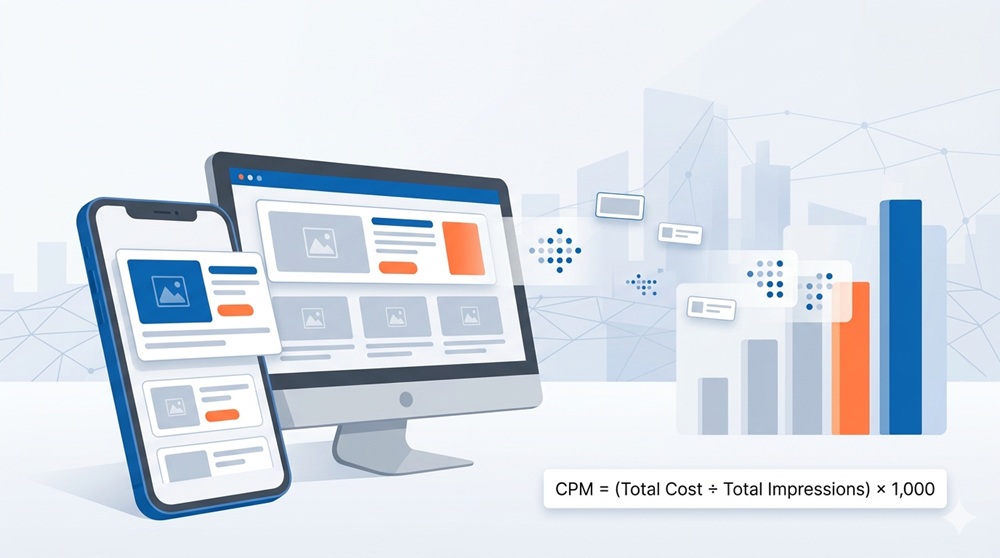
The formula is simple and important to memorize: CPM = (Total Cost ÷ Total Impressions) × 1,000
Worked example
Suppose you spend $500 and receive 200,000 impressions. Applying the formula: CPM = ($500 ÷ 200,000) × 1,000 = $2.50 That $2.50 is the average cost to show your ad 1,000 times.
2. Why CPM matters and when to use it
CPM matters because it gives a predictable unit cost for exposure. Media planners use CPM to estimate how many impressions a given budget will buy and to compare the relative cost of inventory across publishers and channels. You should use CPM when your primary objective is to maximize brand awareness, introduce a new product, run a reach-focused promotion, or deliver storytelling ad formats where the goal is to be seen rather than to drive an immediate click or sale.
CPM is not the only metric you need. Awareness campaigns should still be measurable: track viewability, reach, frequency, brand lift (if possible), and downstream assisted conversions. Treat CPM as the starting point for planning, not the only way to judge success.
3. CPM compared with other pricing models
Comparing CPM to other models helps decide which to use at different funnel stages.
CPM vs CPC (Cost Per Click): CPM charges for impressions; CPC charges only when users click. Use CPM for exposure and CPC for traffic-focused campaigns.
CPM vs CPA (Cost Per Action): CPA ties cost to completed actions such as a signup or purchase. CPA aligns spend directly to outcomes, while CPM aligns spend to reach. Many campaigns combine both: CPM to generate awareness and CPA/CPC for conversion-focused remarketing.
CPM vs CPV (Cost Per View): CPV is common for video ads and charges when a viewer meets a view threshold (for example, 30 seconds or a percentage of video watched). CPM charges per 1,000 impressions regardless of view length unless viewability constraints are applied.
eCPM (effective CPM) is a useful conversion metric. It converts revenue or cost from any pricing model into a per-1,000-impressions equivalent: eCPM = (Total Revenue or Value ÷ Total Impressions) × 1,000. Use eCPM to compare the economics of a CPC campaign with a CPM buy.
4. CPM variants and important related metrics
Not all CPMs are the same. Several variations matter in real campaigns.
vCPM (viewable CPM) means you pay only for impressions that meet viewability standards. For display ads, many vendors use a common standard: at least 50% of pixels in view for at least one second. For video, standards often require two seconds or more. vCPM reduces wasted spend on impressions that never had a chance to be seen.
oCPM (optimized CPM) is a delivery mode where a platform optimizes impression delivery toward a desired outcome (clicks, conversions) while showing cost in CPM terms. Meta uses versions of optimized bidding that behave like oCPM.
eCPM is the effective CPM explained earlier. It lets you compare different buying strategies on a per-thousand-impressions basis.
Viewability rate, invalid traffic (IVT), completed view rate (for video), click-through rate (CTR), reach, and frequency are all companion metrics that explain the actual value of a CPM. A low CPM combined with poor viewability is usually a false bargain.
5. How CPM works on major platforms
Understanding platform specifics helps in planning and expectations.
Google Display Network and DV360 operate via auctions. Your CPM will reflect bids, audience targeting, inventory quality, and viewability. Premium placements and specialized audiences typically come with higher CPMs.
YouTube and Google Ads allow both CPV and CPM-style buys. Video generally commands higher CPMs than static display because of richer storytelling and stronger user attention. YouTube also offers reach buying with CPM/vCPM options across in-stream and in-feed formats.
Facebook (Meta) reports CPM frequently and gives advertisers flexibility to bid for impressions, clicks, or conversions. Meta’s delivery algorithm can optimize towards the objectives you set, which affects reported CPM. Ad relevance and engagement can reduce effective CPM because the platform rewards content that users engage with.
Programmatic environments and Real-Time Bidding (RTB) set CPMs dynamically based on auction dynamics: bid competition, data targeting, and seller floor prices. Private Marketplaces (PMPs) and guaranteed deals typically have higher CPM floors for premium inventory.
6. Calculating CPM – examples and classroom exercises
The calculation is straight forward but practice makes it intuitive.
Reminder of the formula:
CPM = (Total Cost ÷ Total Impressions) × 1,000
Display example
If Cost = $1,200 and Impressions = 800,000, then CPM = ($1,200 ÷ 800,000) × 1,000 = $1.50.
Video example with viewability
If billable viewable impressions = 250,000 and Cost = $2,000, then vCPM = ($2,000 ÷ 250,000) × 1,000 = $8.00.
Blended CPM example
If you spend 80% of your budget on display at a $1.50 CPM and 20% on video at a $8.00 vCPM, the blended CPM is (0.8 × 1.50) + (0.2 × 8.00) = $2.80. This blended figure guides whether your budget meets the target reach.
Practice exercises you can run:
- Calculate CPM for $750 spend leading to 500,000 impressions.
- Convert a CPC campaign result to eCPM: if a campaign spent $400, delivered 800 clicks, and produced 200,000 impressions, what is the eCPM?
- Plan a small awareness buy: with a $1,000 budget and a target CPM of $4, how many impressions should you expect?
7. Factors that drive CPM up or down
Several variables influence CPM and are worth monitoring.
Audience targeting: Narrow, highly valuable segments (first-party audiences, detailed demographics, highly specific interests) usually raise CPM because competition for those users is high.
Placement and inventory quality: Above-the-fold placements, homepage takeovers, and environments with strong editorial context cost more than remnant inventory. Premium publishers and brand-safe environments have higher CPMs.
Ad format: Video, rich media, and larger units (e.g., 300×600) command higher CPMs than small standard banners.
Seasonality and market demand: Peak shopping seasons and event-driven spikes increase advertiser demand and raise CPMs. Q4 is the most notable example.
Competition and bid strategies: More bidders for the same audience drive prices up. Floor prices set by supply-side platforms also set a baseline CPM.
Geography and industry: Developed-country audiences and competitive verticals (insurance, banking, telecom) typically have higher CPMs than emerging markets and less competitive verticals.
Creative quality and relevance: Good creative increases engagement and can reduce effective cost per outcome because platforms favor ads that get positive signals (clicks, shares, dwell time).
8. Benchmarks – approximate CPM ranges (learning guide)
Benchmarks change over time and vary by region, audience and campaign settings. Use these as educational ballpark figures.
Display network CPM (general): $1–$5. Video (pre-roll, in-feed): $6–$30. Social feed (Facebook/Instagram): $2–$12. Premium programmatic or native inventory: $8–$25. YouTube vCPM (viewable): $6–$20.
Always pull current reports for your exact market and adjust expectations per campaign.
9. Measuring success for CPM campaigns
CPM is an input metric. Success depends on outcomes and supporting KPIs. Track impressions, unique reach, frequency, viewability rate, click-through rate, completed view rate for video, and assisted conversions in your attribution model. For awareness campaigns, brand lift surveys and studies provide direct evidence that impressions translated into increased awareness, consideration or favorability.
Use eCPM when comparing campaigns that were bought under different pricing models. Multi-touch attribution and incrementality testing are important because many CPM activities contribute as assists rather than direct last-click conversions.
10. Practical optimization tactics to lower
CPM or improve efficiency Start with creative. Refresh visuals, test different messaging and thumbnails for video, and ensure the creative is designed for the placement. Platforms reward engaging ads with more efficient delivery.
Broaden targeting to find scale. If an audience is too narrow, expand to lookalike or similar audiences to reduce bid competition while maintaining relevance. Use frequency caps to prevent ad fatigue. Exclude low-quality placements based on placement reports and viewability metrics. Consider vCPM for premium buys so you pay for impressions that are more likely to be seen. Dayparting and device targeting can reduce wasted impressions by focusing delivery on high-performance times and devices. Run systematic A/B tests for creative formats (static, carousel, short video). Finally, automate bidding with clear KPIs but monitor closely to avoid objective drift.
11. Common mistakes to avoid Chasing the lowest
CPM without checking viewability or audience quality is a frequent error. A low CPM that delivers poor-quality impressions can harm brand perception and yield no measurable lift. Ignoring viewability and invalid traffic means you may be paying for impressions that never had a chance to be seen. Not connecting CPM buys to measurable outcomes leaves teams unable to justify awareness spend. Over-narrow targeting can spike CPM and limit real reach.
12. Mini case study – planning a CPM-based awareness campaign
A SaaS startup needs 10 million impressions in four weeks and has $25,000 to spend. Using the target-CPM formula, the advertiser calculates target CPM = Budget ÷ (Impressions / 1,000) → $25,000 ÷ 10,000 = $2.50 target CPM.
The recommended mix is scale-focused display at an estimated $1.50 CPM and social video for storytelling at an estimated $8.00 vCPM. With 80% of spend on display and 20% on video, the blended CPM becomes roughly $2.60. That’s slightly above the $2.50 target, so options include negotiating better video vCPMs, increasing the share to lower-cost display, or increasing budget.
Execution rules include a frequency cap (for example, three impressions per user per week), viewability verification via a third-party tag, and a brand-lift survey on a sample cohort. Monitor assisted conversions over a 90-day window to measure downstream impact from these awareness exposures.
H2: 13. Practical checklist for interns and learners Calculate your target CPM from budget and required impressions. Choose channels and formats that match creative and messaging needs. Prepare platform-ready creative with correct sizes and thumbnails. Implement viewability tracking and consider third-party verification if budget allows. Set frequency caps and dayparting rules. Exclude low-performing placements as you get performance data. Run A/B tests on creative and formats, scale what works, and pause what doesn’t. Finally, tie the campaign to measurable KPIs such as reach, viewability, and brand lift or assisted conversions to demonstrate impact.
14. Frequently asked questions
Is CPM the same as cost per thousand?
Yes. CPM literally means the cost per one thousand impressions.
When should I bid CPM vs CPC?
Bid CPM when awareness and reach are primary objectives. Use CPC for traffic-focused or direct-response campaigns.
What is a “good” CPM?
There is no universal good CPM. It depends on platform, audience, ad format, geography and campaign objective. Compare to historical campaigns and industry benchmarks for your vertical.
Does CPM guarantee the ad was seen?
Standard CPM does not guarantee viewability. vCPM or viewability-based buys ensure you pay only for impressions that meet viewability thresholds.
How do I compare CPM across platforms?
Convert results to eCPM for apples-to-apples comparison and account for viewability and audience quality, not just raw CPM numbers.
15. Suggested images and where to place them in the post
Place a hero image at the top of the article showing ad impressions and costing. Add an infographic that explains the CPM formula near the calculation section. Insert a benchmarks chart near the benchmarks section and an optimization flowchart next to the optimization tips. Include a simple blended-CPM visual in the case study section. Use compressed WebP or AVIF formats and add descriptive alt text when uploading.
16. Final takeaways and next steps for learners
CPM is essential for planning and buying awareness-focused advertising. Learn to calculate CPM quickly, understand how platform mechanics and creative affect it, and always pair CPM with viewability and engagement metrics to assess real value. For practice, run a small test with a $1,000 budget, split spend across display and social, set a target CPM, run short A/B tests on creative, and report final CPM, viewability and any assisted conversions you observe.

Leave a Reply