
This is the moment most business owners realise they need to understand CPC, not just as a number on a screen, but as a metric that directly determines whether your advertising budget is working hard for you or quietly draining away.
CPC is one of those terms that sounds technical but is actually quite simple once someone explains it properly. And once you truly understand it, you start seeing your ad campaigns completely differently. You stop guessing and start making decisions based on real data.
In this guide, we’re going to break down everything. What CPC means, how it’s calculated, what factors affect it, how it compares to other pricing models, and most importantly, how you can reduce your CPC and get more leads for less money.
CPC Full Form: What Does CPC Stand For?
CPC stands for Cost Per Click. It is the amount an advertiser pays each time a user clicks on their digital advertisement. Simple as that.
In the world of digital marketing, CPC is one of the most fundamental metrics you will encounter. Whether you are running Google Ads, Facebook Ads, Instagram Ads, or LinkedIn Ads: CPC is the number that tells you the price of a single visitor to your website or landing page.
You will often see CPC used interchangeably with PPC (Pay-Per-Click), but they are slightly different things. PPC is the advertising model, the system where you pay per click. CPC is the actual metric, the specific amount you paid for each click. Think of PPC as the road and CPC as the toll you pay to use it.
For example: if you spent ₹1,000 on a Google Ads campaign and received 50 clicks, your CPC would be ₹20. That ₹20 is what each visitor to your website cost you. Now the question becomes, is ₹20 worth it? That depends entirely on what happens after the click, which we will get to shortly.
How Is CPC Calculated? The Simple Formula
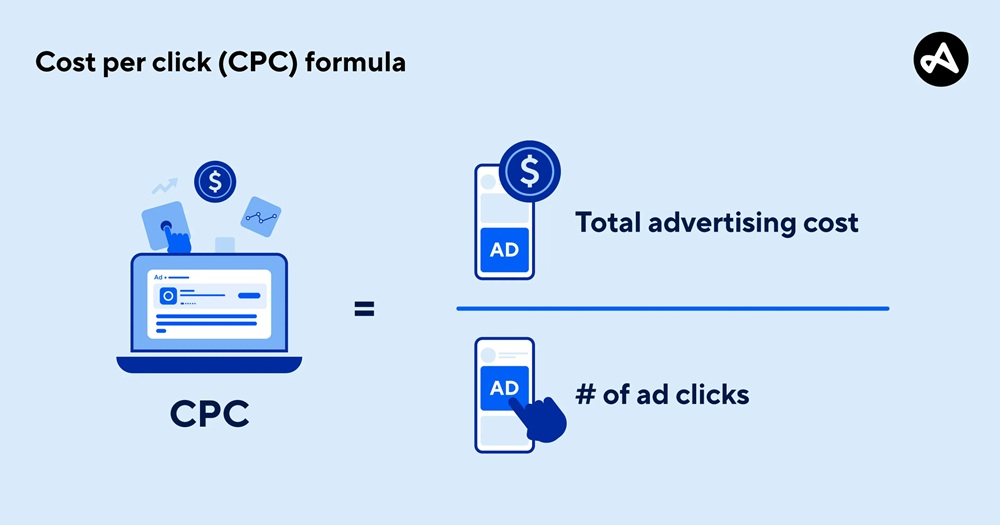
The CPC formula is refreshingly straightforward:
CPC = Total Ad Spend ÷ Total Number of Clicks
Let’s look at three quick real-world examples to make this stick:
| Business | Total Spend | Total Clicks | CPC |
| Local cake shop (Noida) | ₹5,000 | 250 clicks | ₹20 per click |
| Real estate agency | ₹50,000 | 400 clicks | ₹125 per click |
| Online clothing store | ₹10,000 | 1,000 clicks | ₹10 per click |
Notice how the real estate agency pays ₹125 per click, far more than the cake shop. But that does not necessarily mean their campaign is worse. If a single real estate lead is worth ₹50,000 in commission, paying ₹125 to attract that person to your website is a bargain. This is why CPC should never be judged in isolation. It only makes sense when weighed against the value of what you are selling.
It is also worth knowing that on Google Ads, you almost never pay your maximum bid. The actual CPC is determined by the ad auction and is usually lower than what you set as your maximum. Google charges you just enough to maintain your position over the advertiser ranked below you.
What Factors Affect Your CPC?
This is the question that trips up most advertisers. They see their CPC and wonder, why is it this number? Why is my competitor paying less? The answer lies in several interconnected factors:
Industry and competition
- Some industries are simply more expensive than others. Legal services, insurance, real estate, and healthcare consistently have higher CPCs because more advertisers are competing for the same keywords. A keyword like “cheap car insurance” will cost far more per click than “bakery near me” because the profit margins in insurance are higher, so businesses can afford to bid more.
Keyword intent
Keywords that signal strong buying intent cost more. Someone searching “buy running shoes online” is ready to purchase, advertisers will fight hard for that click. Someone searching “types of running shoes” is just browsing. High-intent keywords = higher CPC, but also higher conversion rates.
Quality Score
This is Google’s internal rating of how relevant your keyword, ad copy, and landing page are to each other. It is scored from 1 to 10. A high Quality Score can dramatically reduce your CPC, sometimes by 30% to 50%. This is why ad quality matters as much as budget.
Ad relevance
If your ad copy closely matches what the user searched for, your ad will perform better and cost less. Generic, broad ads that try to appeal to everyone usually end up costing more per click because Google sees them as less relevant.
Landing page experience
Sending clicks to a slow, confusing, or irrelevant landing page damages your Quality Score and drives up your CPC. Google cares about what happens after the click, not just the click itself.
Time of day and day of week
CPC fluctuates based on when ads run. Peak business hours and weekdays typically cost more because more advertisers are competing. Running ads at off-peak times can reduce your CPC significantly.
Device type
Mobile clicks often cost less than desktop clicks in India. However, conversion rates can differ too. Smart advertisers adjust their bids based on which device type delivers the best results for their specific business.
Geographic targeting
Targeting metro cities like Delhi, Mumbai, and Bengaluru costs more than targeting smaller cities or towns because competition is higher in urban markets. For local businesses, tight geographic targeting can keep CPC low and leads highly relevant.
Average CPC Across Industries in India (2025)
One of the most common questions we get from clients is “is my CPC normal?” Here is a reference table of approximate average CPCs across major industries in India to help you benchmark your own campaigns:
| Industry | Avg. CPC (Google Ads) | Competition Level |
| Legal Services | ₹150 – ₹400 | Very High |
| Real Estate | ₹100 – ₹300 | Very High |
| Finance & Insurance | ₹80 – ₹250 | High |
| Healthcare & Clinics | ₹50 – ₹180 | High |
| Education & Coaching | ₹30 – ₹120 | Medium-High |
| Digital Marketing Services | ₹25 – ₹100 | Medium |
| E-commerce & Retail | ₹10 – ₹60 | Medium |
| Restaurants & Food | ₹8 – ₹35 | Medium-Low |
| Local Services (plumbers, salons) | ₹5 – ₹25 | Low |
| Fashion & Lifestyle | ₹8 – ₹40 | Medium |
Use this table as a rough guide, not a hard rule. Your actual CPC will vary based on your targeting, ad quality, and the specific keywords you use. A well-optimised campaign can consistently beat the industry average.
CPC vs CPM vs CPA: What’s the Difference?
Digital advertising offers several different pricing models. Understanding the difference helps you choose the right one for your campaign goal:
| Model | Full Form | You Pay For | Best For |
| CPC | Cost Per Click | Each click on your ad | Driving website traffic & leads |
| CPM | Cost Per Mille | Every 1,000 impressions | Brand awareness & reach |
| CPA | Cost Per Acquisition | Each conversion or sale | Direct sales & lead gen |
| CPL | Cost Per Lead | Each form fill or enquiry | Service businesses & B2B |
| ROAS | Return on Ad Spend | Measured per rupee spent | E-commerce performance |
For most small and medium businesses in India, CPC is the safest starting point. You only pay when someone is actively interested enough to click, meaning your budget is tied to real engagement, not just passive views.
CPM works well for large brands building awareness. CPA is ideal once you have enough data to optimise toward conversions. Most businesses start with CPC and graduate to CPA once their campaigns are mature and well-tested.
Is a Lower CPC Always Better?
This is one of the most important questions in paid advertising, and the honest answer might surprise you: not always.
A low CPC sounds great on paper. But if those cheap clicks are coming from the wrong audience, people who are not interested in what you sell, are in the wrong city, or are nowhere near ready to buy, then a low CPC is actually a waste of money.
Consider this scenario: Business A pays ₹15 per click and gets 100 clicks. 2 of those clicks convert into customers. Cost per customer: ₹750.
Business B pays ₹60 per click and gets 100 clicks. 20 of those clicks convert into customers. Cost per customer: ₹300.
Business B pays 4x more per click, but acquires each customer at less than half the cost. Their higher CPC is completely justified because they are targeting the right people with the right message.
The metric that truly matters is not CPC in isolation, and it is Cost Per Acquisition (CPA) and Return on Ad Spend (ROAS). A ₹60 CPC that produces profitable customers beats a ₹15 CPC that produces nothing every single time.
How to Reduce Your CPC Without Losing Quality
Now for the part every advertiser wants to know. Here are proven, practical strategies to bring your CPC down while maintaining or improving the quality of your traffic:
Improve your Quality Score
This is the single most powerful lever for reducing CPC on Google Ads. Write ad copy that precisely matches your keyword. Make sure your landing page is fast, relevant, and directly connected to what your ad promises. A Quality Score jump from 5 to 8 can cut your CPC by 30% or more.
Use long-tail keywords
Instead of bidding on broad, expensive terms like “digital marketing,” target specific phrases like “digital marketing agency in Greater Noida.” These longer keywords have lower competition, lower CPC, and attract visitors who are much closer to making a decision.
Add negative keywords
Negative keywords prevent your ads from showing for irrelevant searches. If you sell premium web design services, you might add “free” and “cheap” as negative keywords. This stops you from paying for clicks that will never convert.
Tighten your targeting
The broader your audience, the more competition you face. Narrow your geographic targeting, refine your audience demographics, and focus your budget on the people most likely to buy from you.
Test multiple ad variations
Run two or three different versions of your ad copy simultaneously. Over time, the better-performing version will have a higher CTR, which signals relevance to Google and brings your CPC down.
Improve your landing page speed
A slow landing page is one of the most common hidden causes of high CPC. Google includes page speed in its Quality Score calculation. Use Google PageSpeed Insights to check your landing page and fix any issues.
Schedule ads strategically
If your data shows that clicks between 10pm and 6am rarely convert, reduce your bids during those hours or pause ads entirely. Concentrating your budget on high-converting time slots naturally lowers your average CPC.
Use ad extensions
Sitelinks, callouts, call extensions, and location extensions make your ad larger and more informative. They improve your CTR without raising your bid, and a higher CTR leads to a better Quality Score and lower CPC over time.
CPC on Different Platforms: What to Expect
Each advertising platform has its own CPC dynamics. Here is what you should realistically expect when advertising on the major platforms in India:
Google Search Ads
Google typically has the highest CPC of any platform, but also the highest intent. Someone clicking a Google search ad is actively looking for what you offer. For most service-based businesses, Google Ads delivers the best quality leads despite the higher CPC.
Facebook & Instagram Ads
Social media ads generally have a lower CPC than Google, typically ranging from ₹5 to ₹35 per click in India. The trade-off is intent, people on Facebook are not actively searching for you. But with the right creative and targeting, social ads can generate leads at a very competitive cost.
YouTube Ads
YouTube operates on a cost-per-view model rather than pure CPC, but clicks from YouTube can be extremely affordable, often ₹3 to ₹20 in India. Video ads are excellent for building brand awareness and warming up an audience before they search for you on Google.
LinkedIn Ads
LinkedIn has the highest CPC of any social platform, often ₹60 to ₹150 or more per click in India. This sounds expensive until you consider that LinkedIn’s audience is specifically professionals, decision-makers, and business owners. For B2B businesses, that premium audience is worth the higher CPC.
How AdsXLeads Technology Optimises Your CPC
Managing CPC is not a one-time job. It is an ongoing process of testing, analysing, refining, and optimising. Keywords that perform well this month may become expensive next month as more competitors enter the auction. Ad copy that works today may become stale in six weeks. Landing pages that converted well last quarter may need a refresh.
This is exactly the kind of work that AdsXLeads Technology does every day for businesses across Delhi NCR and beyond. Our team monitors your campaigns continuously, adjusting bids, testing new ad variations, refining targeting, and improving Quality Scores, so your CPC keeps trending downward while your lead quality keeps improving.
Here is what working with us looks like in practice:
- In-depth keyword research to find high-intent, lower-competition keywords in your industry
- Ad copy crafted specifically to improve CTR and Quality Score from day one
- Landing page audit and recommendations to maximise conversion rate
- Negative keyword management to stop budget from being wasted on irrelevant clicks
- Bid strategy optimisation aligned with your specific business goals
- Weekly performance reports with clear CPC trends, cost per lead, and ROI data
- Ongoing A/B testing to continuously improve results over time
Want to lower your CPC and get more leads for less? Let’s talk.
adsxleads.com | +91-9910337914
Final Thoughts
CPC: Cost Per Click, is much more than just a number on your Google Ads dashboard. It is a reflection of how well your ads, keywords, targeting, and landing pages are working together. When everything is aligned, your CPC falls naturally and your results improve without you having to keep increasing your budget.
The businesses that win at paid advertising are not necessarily the ones with the biggest budgets. They are the ones who understand their numbers, test relentlessly, and make smart decisions based on data. CPC is one of the most important pieces of that data.
Now that you understand what CPC is, how it works, and what moves it up or down, and you are already ahead of most business owners running digital ads. Use that knowledge. And if you ever want a team that lives and breathes this stuff every day, AdsXLeads Technology is right here.
240214071983

Leave a Reply