
SEO Meaning in Digital Marketing?
SEO (Search Engine Optimization) meaning in digital marketing refers to the process of optimizing a website so that it ranks higher in search engine results pages (SERPs) like Google, Bing, or Yahoo.
The main goal of SEO is to increase organic (non-paid) traffic by making a website more relevant, authoritative, and useful for users searching online.
When someone searches for a keyword like “digital marketing services” or “Google Ads expert in India,” search engines analyze thousands of websites and show the most relevant results. SEO helps your website become one of those results.
In simple terms:
SEO = Improving your website so search engines show it to more people.
Why SEO is Important in Digital Marketing
SEO plays a crucial role in digital marketing because it helps businesses attract targeted traffic without paying for ads.
Here are some major benefits:
1. Increases Organic Website Traffic
SEO helps your website appear in search results when people search for your services or information.
2. Builds Brand Credibility
Websites that appear on the first page of Google are usually considered more trustworthy by users.
3. Cost-Effective Marketing Strategy
Unlike paid advertising, SEO focuses on long-term traffic growth without paying for each click.
4. Improves User Experience
SEO also involves optimizing website speed, mobile responsiveness, and navigation, which improves overall user experience.
5. Generates Quality Leads
SEO attracts people who are already searching for products or services related to your business.
How SEO Works?
SEO is not a one-time activity but a continuous process that evolves with search engine algorithms and user behavior. To understand it better, here’s how SEO works in a practical step-by-step approach:
1. Keyword Research
The first step in SEO is identifying the keywords your target audience is searching for. This includes short-tail keywords like “SEO” and long-tail keywords like “best SEO services in India.”
2. Content Creation
Once keywords are identified, the next step is to create high-quality, informative, and engaging content that answers user queries effectively.
3. On-Page Optimization
This involves optimizing titles, headings (H1, H2), meta descriptions, URLs, and keyword placement to make content search engine friendly.
4. Technical Optimization
Ensuring your website loads fast, is mobile-friendly, and is easy for search engines to crawl and index.
5. Link Building
Getting backlinks from authoritative websites helps improve your domain authority and rankings.
6. Performance Tracking
You can use tools such as Google Analytics and Search Console to monitor traffic, rankings, and user behavior.
How Do Search Engines Work?
Search engines like Google follow three main steps to display results:
1. Crawling
Search engines use automated bots (called crawlers or spiders) to discover web pages across the internet.
2. Indexing
Once pages are crawled, they are stored in a massive database called the search index.
3. Ranking
When someone performs a search, search engines analyze thousands of indexed pages and rank them based on relevance, quality, and authority.
Types of SEO in Digital Marketing
SEO is generally divided into three main categories:
1. On-Page SEO
On-page SEO refers to optimizing elements inside your website.
Examples include:
-
Optimizing page titles and meta descriptions
-
Using relevant keywords naturally in content
-
Adding internal links
-
Improving content quality
-
Optimizing images with alt tags
2. Off-Page SEO
Off-page SEO focuses on activities outside your website that improve your site’s authority.
Examples include:
-
Building backlinks from other websites
-
Social media promotion
-
Brand mentions
-
Guest blogging
Backlinks act as votes of trust, helping search engines determine the credibility of your website.
3. Technical SEO
Technical SEO ensures that your website is easy for search engines to crawl and index.
Key aspects include:
-
Website speed optimization
-
Mobile friendliness
-
XML sitemap
-
Structured data
-
Secure HTTPS connection
Common SEO Techniques Used by Marketers
Digital marketers use several techniques to improve rankings.
Some of the most common strategies include:
-
Keyword research
-
Content optimization
-
Internal linking
-
Link building
-
Website speed optimization
-
Mobile SEO
-
Local SEO
-
User experience optimization
All these techniques help search engines understand the value and relevance of your website.
Key SEO Ranking Factors
Search engines like Google use hundreds of ranking factors to determine which pages should appear at the top of search results. Some of the most important ones include:
- High-Quality Content – Content that is helpful, relevant, and matches user intent
- Backlinks – Links from trusted and authoritative websites
- Page Speed – Faster websites provide better user experience
- Mobile Friendliness – Optimized experience for mobile users
- Keyword Optimization – Proper use of keywords without overstuffing
- User Engagement – Metrics like bounce rate, dwell time, and click-through rate
Understanding these factors helps businesses build a strong SEO strategy.
Example of SEO in Real Life
Suppose someone searches on Google:
“digital marketing course”
If your website appears on the first page, it means your SEO strategy has successfully optimized your website for that keyword.
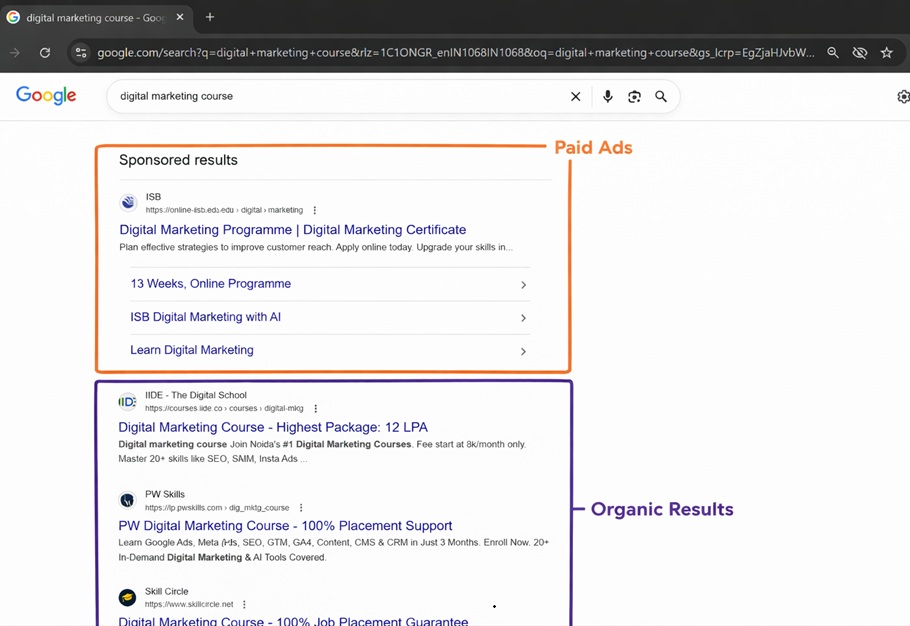
Without SEO, your website may remain invisible to potential customers.
Difference Between SEO and Paid Advertising
| SEO | Paid Ads |
|---|---|
| Free organic traffic | Paid traffic |
| Long-term strategy | Immediate results |
| Builds authority | Stops when ads stop |
| Takes time to rank | Instant visibility |
Most businesses use both SEO and paid advertising for maximum growth.
Common SEO Mistakes to Avoid
Common SEO mistakes can prevent even a well-designed website from ranking. Here are some mistakes you should watch out for:
- Keyword Stuffing– Overusing keywords unnaturally in content
- Ignoring Mobile Optimization– A non-mobile-friendly site loses rankings
- Slow Website Speed- Users leave slow-loading websites quickly
- Duplicate Content- Copying content reduces credibility
- Lack of Internal Linking- Missing connections between pages
- Not Updating Content- Outdated content performs poorly
Avoiding these mistakes can significantly improve your SEO performance.
Future of SEO in Digital Marketing
SEO is evolving rapidly with advancements in technology and changes in user behavior. Here are the key trends shaping the future:
1. AI and Search Engines
Search engines are increasingly using AI to understand user intent better and deliver more accurate results.
2. Voice Search Optimization
With the rise of smart assistants, optimizing for voice-based queries is becoming essential.
3. Zero-Click Searches
Many users get answers directly on Google without clicking, making featured snippets important.
4. E-E-A-T Principle
Google emphasizes Experience, Expertise, Authority, and Trust for ranking content.
5. User Intent Focus
Content must match what users actually want, not just keywords.
Businesses that adapt to these trends will stay ahead in search rankings.
How Adsxleads Helps with SEO
At Adsxleads, we use data-driven SEO strategies to help businesses improve their search rankings and generate high-quality leads. From keyword research to technical optimization and link building, our approach focuses on long-term growth and measurable results.
Conclusion
SEO (Search Engine Optimization) is one of the most powerful strategies in digital marketing. It helps websites attract organic traffic, build credibility, and generate long-term business growth.
By focusing on high-quality content, technical optimization, and authoritative backlinks, businesses can improve their rankings and reach their target audience effectively.

Leave a Reply