
Think of it this way:
When someone types “best digital marketing agency in India,” they are not just browsing; they are ready to take action. SEM helps you capture that moment.
In simple terms:
SEM = Paying to show your business exactly when people are searching for it.
Why SEM is Important in Digital Marketing
Search behavior has changed. People no longer scroll endlessly, they click what appears first and looks relevant. SEM plays a critical role in digital marketing, especially for businesses that want quick visibility and instant traffic.
Here are the key benefits:
1. Instant Visibility
Unlike SEO, SEM allows your website to appear on the first page immediately.
2. Highly Targeted Traffic
You can target users based on keywords, location, device, and even behavior.
3. Measurable Results
Every click, impression, and conversion can be tracked.
4. Budget Control
You can control how much you spend daily or monthly.
5. Fast Lead Generation
SEM is ideal for businesses looking for quick leads and sales.
This is where SEM becomes powerful. With the right campaign setup, you can:
- Show up at the top of search results instantly
- Target high-intent users (people ready to buy or inquire)
- Control your budget without long-term commitment
- Track every click, lead, and conversion
Unlike organic strategies like SEO, SEM gives you speed + precision at the same time.
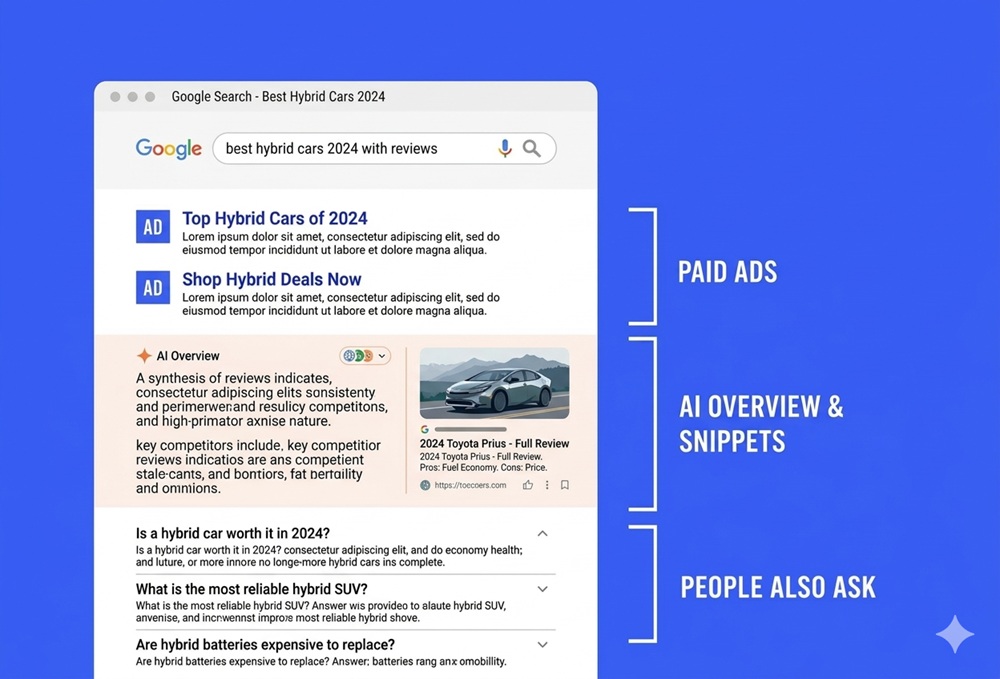
Where Do SEM Ads Actually Appear?
Many beginners assume SEM only means text ads on search pages — but it’s much broader.
SEM campaigns can place your ads across multiple locations:
- Search engine results (top and bottom positions)
- Product listings (Google Shopping ads)
- Video platforms like YouTube
- Websites within the display network
This allows your brand to expand beyond a single placement. A well-structured SEM strategy allows you to stay visible throughout the user journey, from discovery to decision-making.
How SEM Actually Works
Most blogs stop at “bidding system,” but let’s break it in a way that actually makes sense.
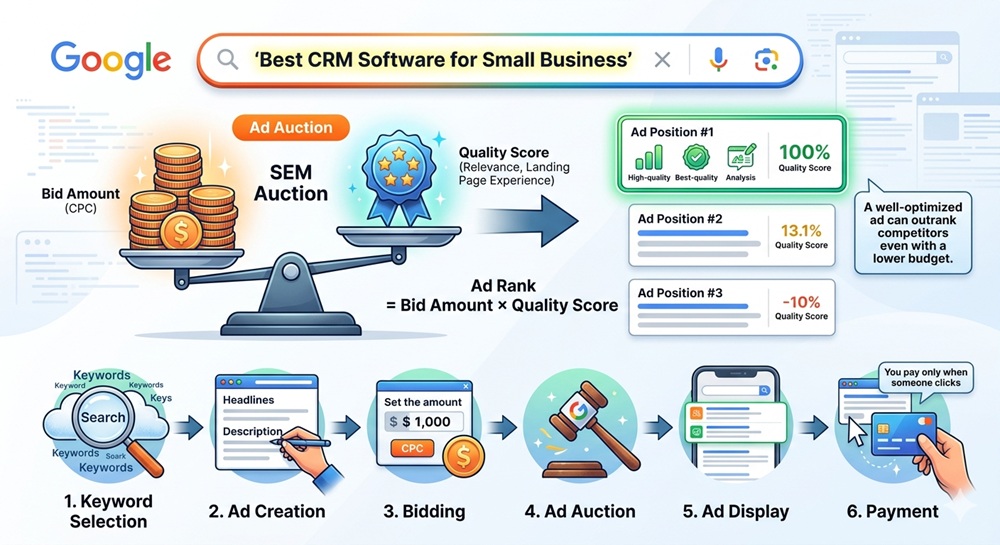
Every time a user conducts a search on Google, an immediate auction takes place in the background.
But winning that auction is not just about money.
Search engines use a formula:
Ad Rank = Bid Amount × Quality Score
Your ad position depends on:
- How much you’re willing to pay (CPC bid)
- How relevant your ad is
- How good your landing page experience is
The answer is why:
A well-optimized ad can outrank competitors even with a lower budget.
Search engine marketing works on a bidding system where advertisers compete for ad placement.
Here’s how it works step-by-step:
1. Keyword Selection
Advertisers choose keywords relevant to their business.
2. Ad Creation
Create compelling ads with headlines, descriptions, and CTAs.
3. Bidding
Set how much you’re willing to pay per click (CPC).
4. Ad Auction
Search engines decide which ads to show based on bid + quality score.
5. Ad Display
Winning ads appear at the top of search results.
6. Payment
You pay only when someone clicks your ad (PPC model).
This area is also where most businesses fail; they focus only on spending more instead of improving ad quality.
Key Components of SEM
To run successful SEM campaigns, you need to focus on:
- Keyword Research
- Ad Copywriting
- Landing Page Optimization
- Bid Management
- Quality Score Optimization
- Conversion Tracking
Each of these components directly impacts your campaign performance.
Types of SEM in Digital Marketing
SEM is not just one format. Each type serves a different business goal.
1. Search Ads (High Intent)
These are text ads that appear when users actively search.
Best for:
- Lead generation
- Service-based businesses
- Immediate conversions
2. Display Ads (Awareness + Retargeting)
Banner ads shown across websites.
Best for:
- Brand visibility
- Retargeting past visitors
- Low-cost impressions
3. Shopping Ads (E-commerce Focus)
Product-based ads with images and prices.
Best for:
- Online stores
- High purchase-intent products
4. Video Ads (Engagement Driven)
Ads shown on platforms like YouTube.
Best for:
- Brand storytelling
- Product demonstrations
- Audience building
5. Remarketing Ads (Conversion Booster)
These target users who already visited your website.
This is where real ROI happens — because you’re targeting warm audiences.
SEM vs. SEO: What Should You Choose?
If you’ve already read your SEO blog, this will connect well.
| Factor | SEM | SEO |
| Speed | Instant results | Takes time |
| Cost | Paid | Organic |
| Intent | High (ready-to-act users) | Mixed |
| Longevity | Stops when budget stops | Long-term |
Smart businesses don’t choose one — they combine both.
Use:
- SEM for quick leads
- SEO for long-term growth
A Simple SEM Strategy for Beginners
If someone is starting from scratch, this is what actually works:
Start with high-intent keywords not broad terms.
Avoid wasting budget on general searches.
Use:
- Phrase match
- Exact match
Create at least 2 – 3 ad variations to test performance.
Send traffic to a focused landing page, not your homepage.
Track:
- Calls
- Form submissions
- WhatsApp clicks
Then optimize based on data, not assumptions.
Common SEM Metrics You Should Know
Understanding metrics is crucial in SEM:
- CPC (Cost Per Click) – Amount paid per click
- CTR (Click-Through Rate) – Percentage of clicks
- Quality Score – Google’s rating of ad relevance
- Conversion Rate – Percentage of users who take action
- ROAS (Return on Ad Spend) – Revenue generated from ads
Real Example of How SEM Works in Business
Let’s take a realistic scenario.
Keyword: “digital marketing agency in India”
- Average CPC: ₹20 – ₹80 (can vary)
- User intent: Very high
- Expected CTR: 5–10% (with good ad copy)
Now imagine:
100 clicks → 10 leads → 2 conversions
That’s where SEM becomes profitable — when your funnel is optimized, not just your ads.
Who Should Use SEM?
SEM is not just for big brands. It works best for:
- Service businesses looking for leads
- Local businesses targeting nearby customers
- E-commerce brands needing quick sales
- Startups testing new offers
If your goal is immediate visibility and measurable results, SEM is one of the fastest ways to achieve it.
Common SEM Mistakes (That Waste Budget)
Most businesses lose money not because SEM doesn’t work, but because they use it incorrectly.
Some critical mistakes include:
- Targeting broad keywords without intent
- Ignoring negative keywords
- Writing weak or generic ad copy
- Sending traffic to slow or irrelevant pages
- Not tracking conversions properly
Even a small mistake here can silently drain your budget.
The Role of AI in SEM (Future Trend)
Search advertising is evolving fast.
Platforms are now using AI for:
- Automated bidding
- Smart audience targeting
- Predictive performance optimization
This shift means manual control is reducing, but strategy is becoming more important.Businesses that adapt early will gain a competitive advantage.
How Adsxleads Can Help You Grow with SEM
Running ads is easy. Running profitable ads is where most businesses struggle. At Adsxleads, the focus is not just on clicks but on conversions and ROI.
We help with:
- Keyword strategy based on intent
- High-converting ad copy
- Landing page optimization
- Conversion tracking setup
- Continuous campaign improvement
If you feel like you’re spending on ads but not getting results, the issue is usually in the strategy not the platform.
Conclusion
SEM (Search Engine Marketing) is one of the most powerful ways to generate immediate traffic, leads, and sales in digital marketing.It gives businesses the ability to appear exactly when users are searching, making it a highly effective strategy when executed correctly.However, success in SEM is not about spending more — it’s about understanding user intent, optimizing campaigns, and improving conversion paths.When combined with SEO, SEM becomes part of a complete growth system — delivering both short-term wins and long-term stability.

Leave a Reply